

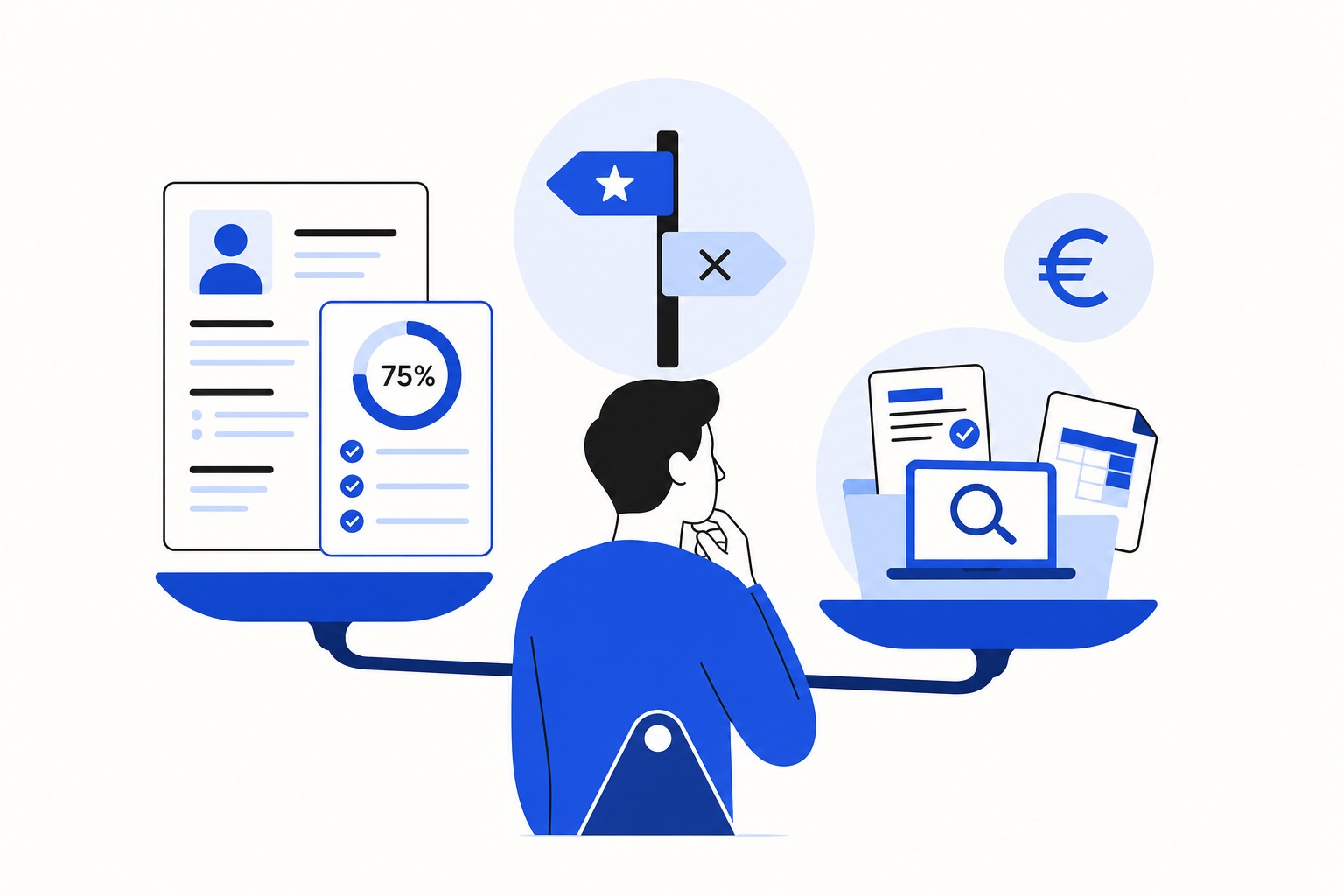
Whether Jobscan is worth paying for depends on two things: how many applications you're sending, and what you actually need from a tool. For a handful of targeted roles, a free check is probably enough. For high-volume searching with built-in rewriting, a paid plan may genuinely save you time. Here is the framework to decide.
Disclosure: I build Parviso, which is compared below. Everything said about Jobscan comes from Jobscan's own website.
What Jobscan does
Jobscan compares your CV against a job posting and returns a match report. The core output is a match rate — a percentage score based on how well your CV covers the hard skills, job title, soft skills, and other keywords in the posting. Education level is factored in only when the listing explicitly requires an advanced degree.
Beyond the score, Jobscan offers:
- AI optimisation — suggests edits to improve keyword coverage and phrasing
- LinkedIn optimisation — compares your LinkedIn profile against the same criteria
- Auto apply — assists with submitting applications at volume
- Resume builder — a free tool to build a CV from scratch in a clean format
Jobscan recommends aiming for a 75% match rate and explicitly warns against keyword stuffing — padding your CV with terms just to raise the score without genuine evidence behind them. On file format, Jobscan recommends submitting a .docx file unless the posting specifically asks for a PDF.
Jobscan has a free resume builder; check jobscan.co for current plans and any free scan limits.
Where Jobscan stops
The match rate tells you whether your CV contains the right words. It does not tell you whether the evidence behind those words is convincing.
A CV that lists "stakeholder management" and one that writes "led monthly reporting calls with six department heads across three countries" both contain the keyword. Only one gives a recruiter something to act on.
For European job seekers specifically, Jobscan's description of its match rate does not mention:
- EU work permit status
- C1 language level requirements
- Regulated profession credentials (for example, BIG registration in the Netherlands or Approbation in Germany)
Whether it flags formatting issues, shows the raw text an ATS extracts, or knows local CV conventions in markets like Berlin or Amsterdam is not clear from its pages, so check jobscan.co.
None of this makes Jobscan less useful. It means you need to know what you are buying.
When paying makes sense
A paid Jobscan plan is worth considering if at least two of the following apply to you:
- You are sending more than ten applications per month and want keyword feedback on each one without doing it manually
- You want AI-assisted rewriting built into the same tool, not a separate workflow
- You are optimising a LinkedIn profile alongside your CV and want both in one place
- You are applying to large organisations in sectors — finance, consulting, logistics — where ATS screening is standard and keyword coverage is a known filter
If you are applying to five or fewer roles at a time, targeting smaller companies, or working in a sector where CVs go directly to a hiring manager, the paid features are unlikely to change your outcome.
When a free check is enough
A free check answers the question that matters most before you apply: does your CV cover what this posting is actually asking for, and will an ATS be able to read it?
Parviso does both at no cost, with no account required. You upload your CV and paste the job posting. Within about a minute, you get:
- A fit verdict — Strong fit, Possible fit, Long shot, or Blocked — based on how well your CV matches the posting's requirements
- A ranked gap list — the requirements your CV does not cover, with evidence quoted from both documents so you can see exactly what is missing and why
- A plain-text ATS preview — labelled "What the ATS sees", this shows the raw text an ATS would extract from your file, so you can catch parsing errors before they cost you a screening pass
Your CV is read in memory and never stored. Parviso’s analysis runs in the EU, it covers 8 languages, and a free account keeps a 90-day history of your scans so you can track changes across applications. See how the scoring works and how your data is handled.
A free check will not rewrite your CV for you. If you need that, Jobscan's paid tier or a dedicated writing tool is the right call. But if you want to know whether a specific CV is right for a specific role — and whether an ATS will read it correctly — a free check covers that.
Comparison: Jobscan paid vs. Parviso free
| Feature | Jobscan (paid) | Parviso (free) |
|---|---|---|
| Match rate / fit verdict | Match rate (%) | Verdict label + ranked gap list |
| Evidence from both documents | Check jobscan.co | Yes — quotes from CV and posting |
| ATS plain-text preview | Check jobscan.co | Yes — "What the ATS sees" |
| AI CV rewriting | Yes | Not offered |
| LinkedIn optimisation | Yes | Not offered |
| Auto apply | Yes | Not offered |
| CV builder | Yes (free) | No |
| Account required | Check jobscan.co | No |
| CV stored | Check jobscan.co | Never — read in memory only |
| Analysis in the EU | Check jobscan.co | Yes |
| Languages supported | Check jobscan.co | 8 languages |
| Pricing | Check jobscan.co | Free |
A practical decision framework
Ask yourself these four questions before paying for anything:
How many applications am I sending per month? Under ten, a free check per role is faster and costs nothing. Over ten, a paid tool starts to save real time.
Do I need my CV rewritten, or do I need to know what is wrong with it? Diagnosis and rewriting are different jobs. Pay for rewriting only if you actually want someone — or something — to do it for you.
Am I applying to large organisations with formal ATS screening? If yes, keyword coverage matters more. If you are applying to a ten-person company in Amsterdam, the hiring manager is reading your CV directly.
Is my CV file actually being parsed correctly? This is the question most people skip. Run a free ATS preview check at Parviso before you spend anything. If the plain-text output is broken, no amount of keyword optimisation will fix it.
FAQs
Is Jobscan free to use?
Jobscan has a free resume builder; check jobscan.co for current plans and any free scan limits — these change regularly.
What does a 75% match rate actually mean?
Jobscan recommends aiming for 75% as a target for keyword coverage. It does not mean your application will succeed — it means the keyword coverage meets Jobscan's recommended threshold. The quality of the evidence behind those keywords is what a recruiter evaluates.
Does Jobscan work for European job applications?
It works for keyword matching regardless of geography. Its match rate description does not mention some things European applicants often face: EU work permit requirements, C1 language level credentials, and regulated profession qualifications. For other European-specific features, check jobscan.co.
Will a higher match rate get me more interviews?
Not automatically. A match rate tells you whether your CV contains the right terms. It does not tell you whether the evidence is convincing, whether your experience is genuinely relevant, or whether the role is a realistic fit. Use it as a diagnostic, not a predictor.
Is Parviso actually free, or is there a catch?
Parviso is free, requires no account, and does not store your CV — it is read in memory and discarded when the check ends. See pricing for the full picture.
What is the ATS plain-text preview and why does it matter?
When an ATS parses your CV, it extracts the text and discards the formatting. If your CV uses columns, tables, or unusual fonts, the extracted text can come out garbled — which means keywords the ATS is looking for may not be found even if they appear in your formatted document. The plain-text preview at Parviso shows you exactly what the ATS receives, so you can catch those errors before you apply.
Should I use .docx or PDF for my CV?
Jobscan recommends .docx unless the posting specifically asks for a PDF. This is a reasonable default for roles where ATS screening is likely. If the posting asks for PDF, send PDF. If it does not specify, .docx is Jobscan's recommended choice.
Conclusion
Jobscan is a legitimate tool with a clear use case: high-volume applications where keyword coverage and AI-assisted rewriting save meaningful time. If that describes your search, the paid plan is worth evaluating. If you are applying selectively to a handful of roles, a free check covers what you actually need to know.
Before you pay for anything, run your CV through a free ATS check at Parviso. If the plain-text output looks clean and the fit verdict makes sense, you have your answer. If it does not, you know what to fix first.